The Constitution establishes Republicanism, not Democracy. The Founders were very suspicious of pure democracy, and so they developed a very complicated system of checks and balances, including the electoral college, a bicameral legislature, and the election of senators by state legislatures (later amended by the 17th amendment in 1913).
The following quotations illustrate their skepticism with respect to democracy, Thomas Jefferson wrote:
- “Were our State a pure democracy, in which all inhabitants should meet together to transact all their business, there would yet be excluded from their deliberations. 1. infants, until arrived at years of discretion. 2. Women, who, to prevent depravation of morals and ambiguity of issue, could not mix promiscuously in the public meetings of men. 3. Slaves, from whom the unfortunate state of things with us takes away the right of will and of property. Those then who have no will could be permitted to exercise none in the popular assembly; and of course, could delegate none to an agent in a representative assembly. The business, in the first case, would be done by qualified citizens only.”
And John Adams said: “Remember, democracy never lasts long. It soon wastes, exhausts, and murders itself. There never was a democracy yet that did not commit suicide.
Alexander Hamilton said: “It has been observed that a pure democracy if it were practicable would be the most perfect government. Experience has proved that no position is more false than this. The ancient democracies in which the people themselves deliberated never possessed one good feature of government. Their very character was tyranny; their figure deformity.”
Finally, John Marshall held “Between a balanced republic and a democracy, the difference is like that between order and chaos.”
The system set up to ensure that there would be no mob rule consisted of three separate branches of government, marked by a bicameral legislature and a Senate which represented the small states and the rural areas, thus thwarting the will of the majority of Americans who lived in the teeming cities. It was a government that was created to represent the interests of the landed gentry (reflecting the British system). I want to look more closely at two features of the Constitution that are particularly anti-democratic –the Senate and the Supreme Court.
The Senate. Every state has two senators, but the population of the states (in 2020) range from California’s 39,512,223 to Wyoming’s 578,579. In other words, each person in Wyoming has 68 times as much power in the Senate as each Californian. This feature gives the twenty-five states with the smallest population, (53 million people), equal power in the Senate to the twenty-five largest states (275 million people). This is not democracy, it’s Montesquieu with a vengeance.
Moreover, according to the web-site Fivethirtyeight the United States population can be roughly divided into four equal geographic parts: rural, exurban, suburban and urban. But the average state (and thus the Senate as a whole) has 35% of its population in rural areas and only 14% in urban areas. The Senate has two and a half times as much rural representation as urban representation. Thus, “Since rural areas tend to be whiter, it means the Senate represents a whiter population, too. In the U.S. as a whole, 60 percent of the population is non-Hispanic white and 40 percent of the population is nonwhite. But in the average state, 68 percent of people are white and 32 percent are nonwhite. It’s almost as if the Senate has turned the clock back by 20 years as far as the racial demographics of the country goes. (In 2000, around 69 percent of the U.S. population consisted of non-Hispanic whites.)”
Moreover, not only is the Senate undemocratic by its construction, it has also adopted procedures which enable it to delay or block legislation favored by the majority of senators. The most important of these procedures is the “filibuster,” an idea that is not found in the Constitution. Using the filibuster to delay or block legislative action has a long history. The term filibuster—from a Dutch word meaning “pirate”—became popular in the 1850’s, when it was applied to efforts to hold the Senate floor in order to prevent a vote on a bill. In the Senate, unlimited debate continued on the grounds that any senator should have the right to speak as long as necessary on any issue.
In 1917, senators adopted a rule (Rule 22), at the urging of President Woodrow Wilson, that allowed the Senate to end a debate with a two-thirds majority vote, a device known as ” cloture.” The new Senate rule was first put to the test in 1919, when the Senate invoked cloture to end a filibuster against the Treaty of Versailles. In the end, the Senate never approved the Treaty, the only treaty in U.S. history that the Senate rejected.
During the 1930’s, Senator Huey P. Long effectively used the filibuster against bills that he thought favored the rich over the poor. The Louisiana senator frustrated his colleagues while entertaining spectators with his recitations of Shakespeare and his reading of recipes for “pot-likkers.” Long once held the Senate floor for 15 hours, but the record for the longest individual speech goes to South Carolina’s J. Strom Thurmond who filibustered for 24 hours and 18 minutes against the Civil Rights Act of 1957.
Filibusters were particularly useful to Southern senators who sought to block civil rights legislation, including anti-lynching legislation. That tactic was finally defeated when cloture was invoked after a 60-day filibuster against the Civil Rights Act of 1964. In 1975, the Senate reduced the number of votes required for cloture from two-thirds to three-fifths, or 60 of the current 100 senators.
Filibusters became more frequent in the 1970’s. In 2013, the Democrats prohibited filibusters for judicial nominations by using “the Nuclear Option,” which allowed a simple majority to end a debate in the case of executive appointments. The Republicans, once they had the majority, extended this simple majority rule to Supreme Court nominations.
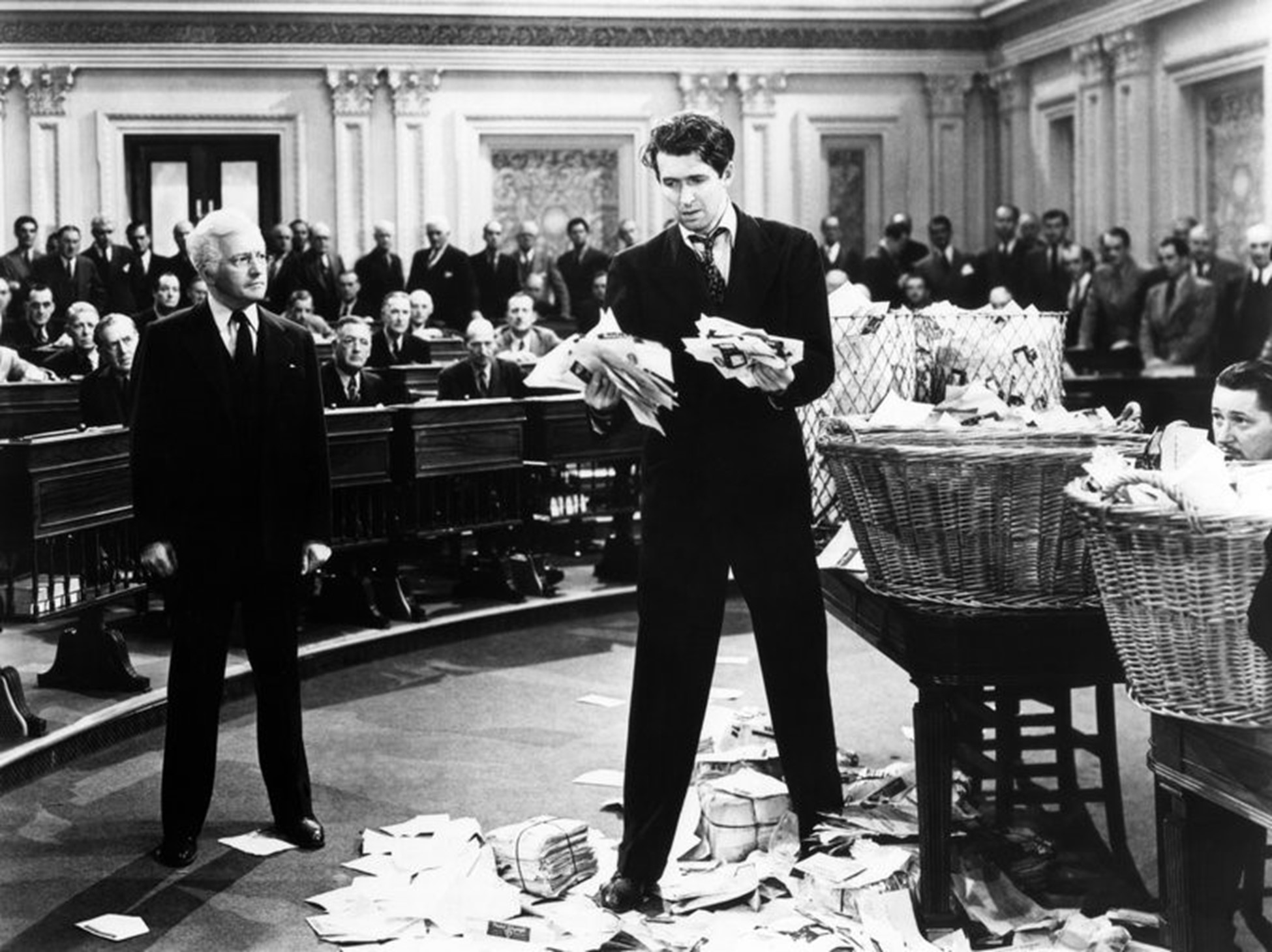
The most famous filibuster ever—Jimmy Stewart in Mr. Smith goes to Washington
Today the filibuster is much different from what it was in the first half of the twentieth century. Senate rules have allowed other business to continue while a filibuster is in force. We are never going to see a Huey Long or a Strom Thurman of, for that matter, a Jimmy Stewart hold the floor for twenty-four weary hours. According to history.com, “Apart from nominations, filibusters have become so ingrained within the Senate’s process that new bills generally do not go to vote unless the leadership is assured they have at least 60 votes. Even the prospect of a filibuster can hold up a final vote or force a bill’s supporters to make changes in a bill.” What that means is that the “World’s greatest deliberative body” can deliberate, but not legislate. The last time Congress completed all bills on time was 20 years ago, in 1996. Instead of a functioning appropriations process, Congress has resorted to massive omnibus appropriations bills and continuing resolutions that carry over spending from the previous year.
The Supreme Court. The Constitution doesn’t have a whole lot to say about the Supreme Court. Article III Section 1 says, “The judicial Power of the United States, shall be vested in one supreme Court, and in such inferior Courts as the Congress may from time to time ordain and establish. The Judges, both of the supreme and inferior Courts, shall hold their Offices during good Behaviour, and shall, at stated Times, receive for their Services, a Compensation, which shall not be diminished during their Continuance in Office.”
The Constitution goes on to say, “The judicial Power shall extend to all Cases, in Law and Equity, arising under this Constitution, the Laws of the United States, and Treaties made, or which shall be made, under their Authority;—to all Cases affecting Ambassadors, other public Ministers and Consuls;—to all Cases of admiralty and maritime Jurisdiction;—to Controversies to which the United States shall be a Party;—to Controversies between two or more States;— between a State and Citizens of another State,—between Citizens of different States,—between Citizens of the same State claiming Lands under Grants of different States, and between a State, or the Citizens thereof, and foreign States, Citizens or Subjects.”
The actual limits on the Court’s remit were decided in the landmark 1803 case Marbury v. Madison. The Court’s historic decision established that the U.S. Constitution is actual “law”, not just a statement of political principles and ideals, and helped define the boundary between the constitutionally separate executive and judicial branches of the federal government. In particular, it gave itself the right to review laws enacted by Congress to determine their constitutionality. American courts thus have the power to invalidate laws that they find to violate the Constitution. The balance of power between the judiciary and the other branches of government has oscillated. The past two decades, when the court has intervened to decide an election, legalize same-sex marriage and throw out multiple laws, represent a high point for what scholars call “judicial supremacy.”
The Constitution does not call for life tenure for justices. It’s not normal anywhere else in the world. In no other democracy do judges serve for as long as they like; in most other democracies, the highest courts are less aggressive about striking down entire laws. The courts instead tend to direct legislators to fix specific parts of a law.
The Constitution also does not state how many justices should sit on the Supreme Court. According to the National Constitutional Center, The Judiciary Act of 1789 established the first Supreme Court, with six Justices. “Since 1789, Congress changed the maximum number of Justices on the Court seven times. In 1801, President John Adams and a lame-duck Federalist Congress, in an attempt to limit incoming President Thomas Jefferson’s appointments to the high bench, passed the Judiciary Act of 1801, which reduced the Court to five Justices. Jefferson and his Republicans soon repealed that act, putting the Court back to six Justices. And in 1807, Jefferson and Congress added a seventh Justice when it added a seventh federal court circuit.
“In early 1837, President Andrew Jackson was able to add two additional Justices after Congress again expanded the number of federal circuit court districts. Under different circumstances, Congress created a 10th circuit in 1863 during the Civil War, and it briefly had a 10th Supreme Court Justice. However, Congress, after the war. passed legislation in 1866 to reduce the Court to seven Justices to thwart the ability of President Andrew Johnson, [a man the Congress loathed], to appoint new justices. That only lasted until 1869, when a new Judiciary Act set the number back to nine Justices.” So, there were six justices in 1789, five in 1801, seven in 1807, nine in 1837, ten in 1863, seven in 1866, and nine in 1869. Each of these efforts by the executive and the congressional branches to change the number of justices was political, an attempt to make the Court more accommodating to a specific political perspective. This was also true of President Roosevelt’s attempt to “pack the court” in 1937.
The Supreme Court is by nature a conservative institution, trying to align laws with the Constitution, whatever the theory of interpretation is. For many years this meant the Court made really bad law. For example, in the famous 1857 Dred Scott case “the Supreme Court of the United States held that the US Constitution was not meant to include American citizenship for black people, regardless of whether they were enslaved or free, and so the rights and privileges that the Constitution confers upon American citizens could not apply to them.” That it frequently made racist decisions can be understood by remembering that before the Civil War two-thirds of all justices were slave-owners,

Thirty-nine years later, in Plessy v. Ferguson in 1896, the Court established the principle of “separate but equal” with respect to public facilities. In 1908, in Muller v. Oregon, the Court ruled that Oregon’s restrictions on the working hours of women are constitutional under the Fourteenth Amendment because they are justified by the strong state interest in protecting women’s health. In 1944 in Korematsu v. The United States, the Court upheld the right of the federal government to intern Americans of Japanese ancestry. In 1986, in Borders v. Hardwick the Court found that A Georgia law that criminalizes certain acts of private sexual conduct between homosexual persons does not violate the Fourteenth Amendment.
All of the cultural conflicts that plague our politics (race, gender, abortion, same-sex relations) were originally decided in the Supreme Court on the side of narrowing the rights of plaintiffs, but those cases have been overruled in a series of Court decisions in the last 80 years. A few of the landmark decisions:
- Brown v. Board of Education, (1954): Segregated schools in the states are unconstitutional because they violate the Equal Protection Clause of the Fourteenth Amendment. The Court found that the separate but equal doctrine adopted in Plessy v. Ferguson (1896) “has no place in the field of public education”.
- Loving v. Virginia, (1967) Laws that prohibit interracial marriage (anti-miscegenation laws) are unconstitutional.
- Frontiero v. Richardson (1973), a case argued by Ruth Bader Ginsburg, sex-based discrimination is inherently suspect.
- Goodrich v. Department of Public Health (2003), the denial of marriage licenses to same sex couples does not meet a legitimate state interest.
- Roe v. Wade, (1973), Laws that restrict a woman’s ability to have an abortion prior to viability are unconstitutional.
Generally, the Court is years, if not decades behind the public. In that sense, it is frequently undemocratic. According to Gallup 62 percent of the American people called themselves pro-choice in 2019, while 37 percent called themselves pro-life. Clearly the American people have spoken on abortion even as the Supreme Court is getting ready to move the clock backward to the 1970s.
It is important to remember that the United States is not a democracy, despite all the rhetoric to the contrary. Given the difficulty of amending the Constitution there isn’t much we can do to expand democracy beyond protecting voters’ rights and continuing to make clear how undemocratic certain aspects of the American Government really are. And it is this democratic shortfall that makes attempts to regulate guns more strictly likely to fail more often than not.
 An economist without guile